

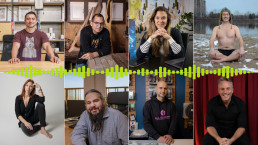
Behind Every Entrepreneur, a Story Worth Hearing
In 2020, the lockdowns cut everyone off at once. Events were cancelled, offices sat empty, and every conversation I had with my network happened through a screen — when it happened at all. I felt that disconnection myself, and I could see it in the people around me. So I started Behind the Human / L’humain derrière to bring some of that connection back: for me, for the people in my network, and for everyone listening from home who was living the same isolation.
The guests came from my own circles — members of Ideal Coworking, the coworking space I was running at the time, neighbours in Saint-Henri, people I’d crossed paths with along the way. The format was simple: informal, long-form conversations, with no script and no time limit. And from the start, I wanted the show to stay bilingual. Each guest spoke in their own language, French or English, so the conversation felt comfortable and fluid for them — and so the show stayed true to the way Montréal actually talks.
The Challenge
Most interview podcasts are built for reach: tight runtimes, punchy hooks, guests chosen for name recognition. I wanted the opposite — conversations long enough for people to stop performing. Episodes running past two hours, no script, and guests who were respected in their own worlds but not famous. That was a deliberate bet, and it came with a real cost: long, unscripted and unknown is hard to promote.
Promotion turned out to be the hardest part of the whole project. My plan was to let the audience grow organically — each guest sharing their episode with their own network, one circle reaching the next. It wasn’t enough. The conversations were there; the listeners didn’t follow in the numbers I’d hoped for.
My Role
I ran it end to end. I named the show, chose and researched every guest, wrote and recorded each introduction, and conducted the interviews. I handled the full production and post-production, and cut the soundbites that promote each episode. I shot each guest’s portrait, built the show’s Instagram account, and published every episode to Buzzsprout, Apple Podcasts, Google Podcasts and Spotify. The one piece I didn’t make was the intro track — that came from my brother, Jesse Landriault (check out : Disociate on SoundCloud).
Most of the conversations happened in our meeting room at Ideal Coworking: quiet, familiar, away from phones and to-do lists. For four of them — Amber-Dawn, Jean-René, Mehdi and Dominic — I brought the recorder to them, including Amber-Dawn’s art studio, Appwapp’s open-plan office and the listening room at Audiophonie. We took the necessary COVID precautions at every session. I came in with an outline, then followed the conversation wherever it went — Bruce Lee’s training lineage, Jungian archetypes, Yellowstone bacteria, the ethics of sex work. Each episode opens on a short line pulled from the conversation, then the bilingual sting, then my introduction of the guest — and then the edit gets out of the way.
I started with a genuine interest in people’s authenticity and a desire to really connect, one long conversation at a time. Guests walked away feeling heard and empowered. That’s what made it so fulfilling.
I wasn’t a neutral interviewer, and didn’t try to be. When something surprised me, I said so. When I disagreed, I said that too — respectfully, and on tape. Those turned out to be the moments that made each episode worth listening to.
The Work
Eight episodes in all. Seven are released — four in French, three in English, close to twelve hours of conversation recorded between 2020 and spring 2021 — and an eighth, with Dominic Boudreau, is waiting on its final edit. Each released episode lives on the project page as a short soundbite and a full episode, with an introduction that tells you who the guest is and why you might want to get in touch. Taken together, they’re a cross-section of Montréal at a strange moment. A gymnast turned engineer turned coach. An architect who sculpts light. A founder who lost her voice and got it back. A microbiologist who tests the claims of his own practice. An artist who turned sex work into a ceremony. A programmer who started his first business at eight. A marketer who bought a hi-fi repair shop when the festivals went dark. And one more conversation still to come.
Episode 1 : Mizar Fuentes-Ortega (French)
Mizar is a coach and co-owner of MFO Training, a gym on rue Saint-Ambroise in Saint-Henri. He’s a former Quebec provincial gymnastics champion and a mechanical engineer by training, with a biomedical specialization from Dalhousie. He has been coaching since he was 14.
Summary
We traced his path from gymnastics to engineering to coaching. That includes the honest moment he realized the Olympics weren’t realistic, and chose school instead. Mizar walked through what shaped his method: Jeet Kune Do under Patrick Chan, in a lineage that runs back to Bruce Lee, and years of mentorship with James FitzGerald, the first CrossFit Games champion, whose coaching group he now belongs to.
His core idea is simple and stubborn. Measure the starting point. Define what a person actually needs their body to do. Build from there. No 30-day challenges, no cookie-cutter programs. The goal isn’t a six-pack; it’s still being able to walk, bike and kayak at 80. We closed on how COVID pushed MFO toward fully individualized coaching without losing its community.
Episode 2 : Alberto Palomino (English)
Alberto is a Montréal light sculptor and the designer behind Light to Matter. He trained as an architect in Lima and at Université de Montréal, and designs lighting for architects and interior designers in New York, Toronto and Montréal. We met at Ideal Coworking and have collaborated on several projects since.
Summary
Alberto took an easy-credit sculpture class in architecture school and found the thing he’d come back to twenty years later, after an MBA and a corporate career that never quite fit. We talked through the ideas inside his pieces: Jungian archetypes, the difference between chaos and disorder, and the “void at the center” — a hole he drilled out of frustration into a mahogany sculpture that became his central tenet. Emptiness is possibility.
He made a strong case against art that lives in gallery silence. Work should be useful, sold and lived with, which is why he sculpts light. We ended on his plans for a Toronto showroom, and a longer dream: a woodworking shop that teaches a trade to kids who’ve lost their way, the way one gave him one of his first jobs in Canada.
Episode 3 : Anne-Marie Denault (French)
Anne-Marie is the founder of Tripura, an intelligent breathing-guide app. A McGill business and accounting graduate who spent three years at Deloitte, she rebuilt her path around breathwork after an accident took her voice.
Summary
A car door opened in front of her bike. She ended up in intensive care, and doctors told her the damage to her vocal cord meant she would likely never speak normally again. She went to an ashram instead — yoga, meditation, breathing practice — and came back with her full voice, to her doctor’s disbelief. She went on to train in France, the Himalayas and southern India.
Tripura, the Sanskrit name she was given at the ashram, is how she’s sharing it: guided sessions built on pranayama, animated to show how the body should move, and designed to adapt to each user’s breathing. Pulmonologist partners and letters of interest from hospitals were lined up for clinical programs. We recorded days before launch, on the eve of Quebec’s second wave.
Episode 4 : Sebastien Zappa (French)
Sébastien is a microbiologist at Université de Montréal and a certified Wim Hof Method instructor. His research career took him from France to Indiana University before landing in Montréal.
Summary
Sébastien brings something rare to breathwork and cold exposure: a scientist’s skepticism. He came to the method after a decade of chronic illness that neither conventional nor alternative medicine had resolved, and built up to it slowly — a reminder that what looks easy on YouTube can be too much for someone already depleted.
We dug into what the evidence actually shows (the autonomic nervous system, adrenaline, inflammation markers) and where the claims outrun it. He explained why he refuses to teach any spirituality alongside the technique, and why fundamental research matters, using PCR — born from curiosity about bacteria in Yellowstone’s hot springs — as his example. We also disagreed, cheerfully, about whether suffering really makes us stronger.
Episode 5 : Amber-Dawn Bellemare (English)
Amber-Dawn is a multidisciplinary artist based in Saint-Henri, creator of The Parlour Project and founder of the Wolf Lab, a nonprofit women’s art collective. She’s also National Programming Coordinator for the Canadian Unitarian Council’s Truth, Healing and Reconciliation initiative, and one half of the visual storytelling duo Bad Buddha.
Summary
We recorded in her studio, where she first staged The Parlour Project in 2019. It’s an autoethnographic art event built from more than 1,800 before-and-after selfies taken during her years as a sex worker, reshaped into an immersive ceremony with projection, music and a facilitated debrief. Her aim is loving kindness: invite people to fill in the gaps with their own judgments, and let them see themselves.
The conversation went where few podcasts would — consent, decriminalization, the commodification of the feminine. At one point her word “product” stopped me. I said so, and we worked through it on tape. She also shared the story behind the Wolf Lab, named for Women Who Run with the Wolves, and her plans to tour Parlour once venues reopen.
Episode 6 : Jean-René Auger (French)
Jean-René is the founder of Appwapp, a Montréal web and mobile software development firm. He started his first business at eight and has been programming since he was ten.
Summary
We recorded in Appwapp’s open-plan office, where even the tough meetings happen in the kitchen. This is a conversation about building a company on your own terms. Jean-René told it from the beginning: reselling lost golf balls at an exclusive Toronto club at eight, teaching himself QuickBASIC, a web hosting company he built over a decade and sold to an American company, then starting Appwapp with his wife in a borrowed loft across the hall.
He was candid about how hard banks make life for entrepreneurs, about the hand-picked team of twelve he set out to build and reached in 2020, and about choosing to stay small enough to know everyone. Plus: Appwapp’s first product, a serious rum collection, and a road trip to Las Vegas that nearly ended on a mountain pass near Cheyenne.
Episode 7 : Mehdi Kazemian (English)
Mehdi is an entrepreneur and lifestyle coach, owner of Audiophonie, a high-end hi-fi repair shop in Montréal, and producer of the Kaz Lifestyle YouTube channel. He studied at John Molson School of Business and was a member at Ideal Coworking.
Summary
When COVID cancelled the festivals his outdoor media company depended on — the Grand Prix, MURAL — Mehdi didn’t wait it out. He bought a local audio repair shop he found on Facebook, in an industry he only knew as a teenager building his own speakers, and started running it with a sales and marketing lens.
We talked about the job that stopped paying its staff the same month he bought his first property, why he went out on his own in 2010, and his belief that attention is today’s real currency: the only way to earn it is to add value. We recorded in Audiophonie’s listening room, with one of Alberto’s sculpted tables in the front window.
Episode 8 : Dominic Boudreau (French)
Unreleased content. Currently in post-production. Coming soon.
The Outcome
Reach is where the show fell short. The organic approach never built the audience I wanted, and looking back, the gap is clear: a show like this needed a promotion strategy as deliberate as the conversations themselves. That means showing up in the right online groups, partnering with complementary brands, and trading appearances with other podcasts. That’s what I would have done if I’d kept it going, and it’s what I’ll do when episode eight comes out.
But the real measure of the show was never the download count. It was the guests. Several of them told me afterward, each in their own way, how validating the experience had been — first in the room, being listened to without a clock running, and again when they heard their own story played back. Hearing them say that was success enough for me.
That feeling came from trust. Guests went places they rarely go on record — a voice lost and recovered against a doctor’s prognosis, a decade of chronic illness, the inner life of sex work — because the format gave them room to. The guests started showing up in each other’s worlds, too: by episode seven, one of Alberto’s sculpted tables was sitting in the front window of Mehdi’s shop. And in the middle of the isolation, it turned a network gone quiet into living relationships again — and gave the people who did listen at home a bit of the company they were missing.
What I learned
Behind the Human is the project where my values and my work lined up completely. It started with a genuine interest in people’s authenticity. It became one-on-one, long-form conversations designed to make guests comfortable enough to open up. And it ended with them feeling heard and empowered. Authenticity, connection, empowerment — the three values I try to live by, in a single project. That’s what made it so fulfilling, and it taught me to measure success by the people in the room before the numbers. It also taught me that the best brief isn’t written; it’s heard. And that great work doesn’t travel on its own: I put everything into the conversations and trusted them to find their audience. Today I treat distribution as part of the creative, not something that happens after it.
Hey! If this is the kind of thinking your team needs — for a position, a project, or just a conversation — I’d love to hear from you.