

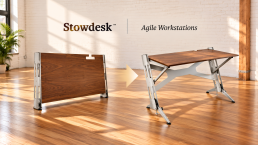
Startup Momentum For The Flexible Workspace
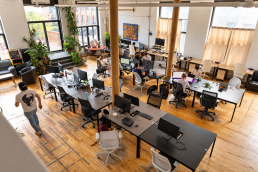
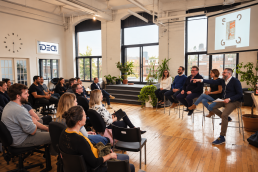
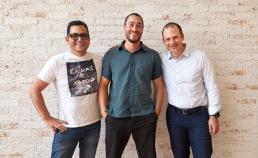
In 2017, my coworking space, Ideal Coworking, moved to a new location. I wanted the main open area to double as an event space. That meant desks that could disappear fast without looking like folding tables. So I asked Alberto Palomino to design one; he’s an industrial designer, architect and sculptor I’d shared the space with. Three prototypes later, we brought in Ilann Derche, an aeronautics engineer working out of the new space, to close the technical gap. Stowdesk became a three-partner startup, and I took on brand development and marketing.
The Challenge
Our first instinct was high-end. Alberto’s network ran through top architecture and interior design firms, and the product looked the part. But the clients who actually needed a desk that folds away in 30 seconds were coworking and flexible-workspace operators. They didn’t have budgets for premium furniture, no matter how much easier it made their events. Their real alternative was IKEA. If we stayed premium, we’d be selling a beautiful answer to a market that couldn’t afford it.
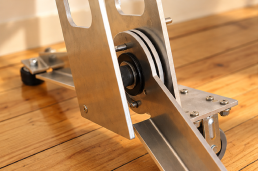
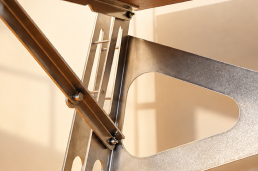
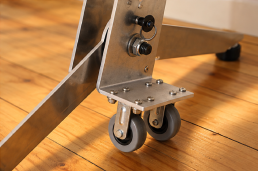
My Role
So we repositioned. The entry price came down to roughly $800 USD per desk, a number an operator could justify. That shift rippled through everything I owned on the brand side. Our working name, Momentum, suddenly felt too lofty for the price point. We needed something friendly, direct and accessible, a name that said what the product did. Stowdesk won. We didn’t throw Momentum away. It became the model name, the Momentum 4, so the aspiration lived on in the product while the brand stayed approachable.
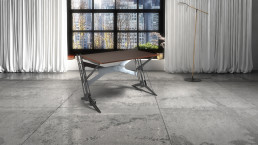
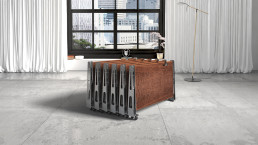
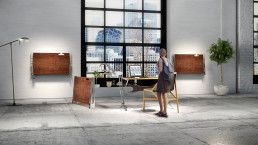
The audience had a second layer. Operators were the end clients, but architects and interior designers were still the ones specifying and buying on their behalf. So I kept the visuals in the language that audience trusts. Alberto brought in a 3D artist he’d worked with on architectural projects. I directed the renders to stay on brand while keeping that architectural-visualization style. The brand spoke to the operator’s budget. The imagery spoke to the specifier’s eye.
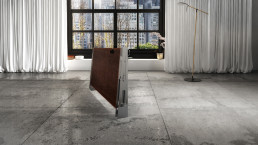
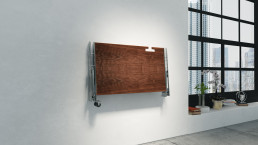
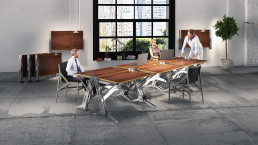
The Work
I built the identity around that balance:
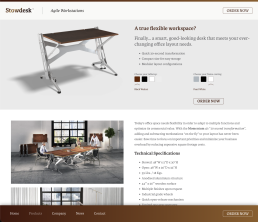
- a warm serif wordmark
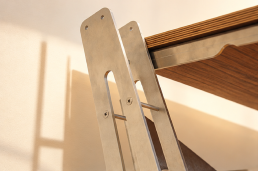
- a walnut-and-bronze palette drawn from the product’s own materials
- an “Agile Workstations” descriptor that framed it as office infrastructure, not a folding table
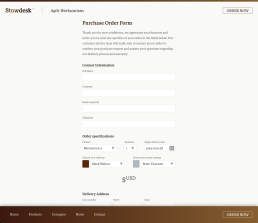
The website let buyers configure their own desk by choosing tabletop and frame finishes, then send an order with a preliminary quote. Around it, we produced fold and unfold demo videos, a sales presentation, business cards, and the tools behind the outreach: a cold-call script, a sales pipeline and a CRM.
The Outcome
It landed where it needed to. We pitched the Momentum 4 to an international office-furniture manufacturer on Montréal’s South Shore and moved into negotiations on production costs and margins. Architecture firms in New York and Montréal were ready to talk business. Both sides were waiting on the same thing: a fifth and final prototype.
That’s where the story turns. Our seed funding was spent, and we were courting investors for that last prototype when Ilann stepped back to focus on a venture with a faster road to profitability. Outside engineering firms quoted heavy fees and long timelines. We were a small account, and they had bigger fish to fry. Without our lead engineer or the funds to replace him, Stowdesk was shelved.
The brand spoke to the operator’s budget. The imagery spoke to the specifier’s eye.
What I Learned
Stowdesk taught me what a partnership actually carries. Losing Ilann didn’t just cost us engineering capacity. It cost us founder conviction, and no outside firm could replace either one. Nobody prioritizes your business like someone with a stake in it. Today I look hard at alignment before I commit: is everyone around the table focused on the same thing, at the same time? Our brand and our market were ready. The partnership needed to be just as ready.

Hey! If this is the kind of thinking your team needs — for a position, a project, or just a conversation — I’d love to hear from you.